Monday, December 30, 2013

Pig Farm Construction Equipment


Pig farm construction focuses on housing facilities, feeding and ventilation systems, temperature and environmental controls and the economic viability of their operations. Just as producers have to determine profit margins and types of facilities and equipment for their farm, you must also find the practices that best fit their specific situation. Some procedures and treatments are known to stress the animals and producers should consider the animals' welfare, health and management in correspondence with accepted husbandry skills.


Pig Feeders Equipment
There are two kind of pig feeder,such as pig feed through and dry wet pig feeder. Feed trough is used to supply fresh feed or supplementary feeding to sows, piglets and fattening pigs. The dry-wet feeder integrates automatic feeding & drinking function. It is suitable for both powder feedstuff and feed pellets. The feed can be delivered evenly through the delicate valve, and it also has automatic regulation device. The drinker can make pigs do less running between feeder and waterer, and one pig feeder can meet the demand of 40 pigs of 100 kg each.

Pig Waterer Equipment
The pig farming drinker equipment such as piglet waterer bowl and duck-billed pig drinker .The drink bowl often made by plastic or stainless steel. It includes two parts: water cup and spring valve . When the pig wish to drink, it will push pressing plate, and the plate will drive the outlet valve, so the water will flow to the cup from the pipe. When pig stops drinking, the spring will haul back the valve and stop the water. There’re two kinds of duck-billed drinker, the small one with flow of 2-3L/min, and the big one with flow of 3-4L/min. The small one is suit for piglet, and the big one is suit for fattening pig and adult pig.

Cleaning Equipment
Modern pig farm in order to maintain the cleanliness of the column, reducing manual cleaning, generally laying manure ditch fecal leakage floor pig defecation urination fecal leakage on the floor, urine flow into the gutters with the gap stool fell on fecal leakage floor on after their stampede automatically fall into the gutters
of the following pig feces in order to avoid contact, help prevent and reduce the incidence of epidemic diseases.

Amisy pig farming equipment has a full selection of pig equipment designed for piglets breeding, sow farrowing, fattening pigs breeding and adult pigs breeding. The hot sale products are pig farrowing crate, sow gestation crate, piglets nursery crate, pig feeders and waterers. Besides we also supply piggery cooling & ventilation machines, piggery warming machines, etc.

Email:nicholepandora@gmail.com or info@pig-farming.net

Friday, December 27, 2013

Modernized Pig Farms in Russia

Russia is the world’s largest country stretching 11 time zones from Europe to Alaska. And Russia is currently seeing massive increases in pig meat production in an attempt to become self sufficient.

Russia is well-known for its state farms. These were large farrow to finish units of up to 6,000 sows. Although still in production many of these farms are now old with low productivity and in need of refurbishment.


According to the Russian Federal State Statistics Service reports, 2013 Russia pig inventories are approximately 18.8 million head and this is a noteworthy increase over the past years. And the big increase is a result of reducing backyard production (about 10% by volume) because of the outbreaks of African swine fever and reducing the competitiveness of informal pig producers compared with modernized pig farmers.

As a result of joining the WTO, prices for live pigs fell, and this led to the market being flooded with imported products, which is a little contrary to Russia’s attempt to realize the pig production self sufficient. Even though the efficient pig production has given rise to the increase in the number of domestic swine and pig herd, in light of the increased competition around the world, Russian pig farmers still have to work more efficiently. At the same time, a serious challenge to pig farmers and pig production in the country’s domestic market, which is posed by the Russia’s accession to the WTO, is another big reason.

The weekly survey of Russian pork market provides the convincing evidence that in order to achieve growth in pig production, business in the agriculture sector must invest in new areas—the modernized pig farms with latest pig equipment.

So Russia has a new breed of pig farmers. They are companies that previously engaged in slaughtered or imported and processed meat, building pig farms; and completely new companies starting from scratch and building farms, feed mills and slaughter-processing plants. These modern units fit into 2 main categories: one is multi site with sow farm, 1/2 nurseries sites and 2/3 finisher sites, which can hold 5,000 sows; the other is the site can manage 2500-3000 sows from farrowing to finishing. Most new farms are fully integrated with land to produce feed ingredients and for slurry disposal, feed manufacture, farms, slaughter-processing.

These new breed of pig farmers employ the latest pig farming equipment and techniques to do the pig raising, combined with feed manufacturing, slaughtering, processing and manure producing, etc. forming a vertical integrated pig farm which is not only saving the investment cost at some level, but also proving the ecological pig farming.

Email:nicholepandora@gmail.com or info@pig-farming.net

Monday, December 23, 2013

Modern Systems for Pig Farrowing Management

In modern pig farrowing management, housing equipment plays a very important role in economic success. Future oriented planning and technically sophisticated systems allow Amisy to supply every farmer with the optimum equipment to meet their requirements.

Whether it is a new house or refurbishment of existing houses, our specialists will cooperate with you to develop the optimum plan for economical pig farrowing housing equipment management.

Service center with sow crate stands

The service center is the starting point for the production of healthy and vital piglets. Optimum positioning of sow crate stands will ensure good results, since the right atmosphere promotes a distinct, rapid and uniform sow heat. Amisy offers optimum solutions to match your specific farm conditions.

Pregnant sows in sow crate stands can easily be surveyed and controlled individually. Aggression during feeding cannot occur. Artificial insemination is easily carried out. Even under group management, some separate sow crate stands should be available for housing sows which return to heat, animals with leg problems or vicious sows.

Pig farrowing crate is also called pig farrowing house or pig farrowing fence. A pig farrowing crate includes sow locating frame, piglet fence, piglet incubator, manure dropping floor, trough for sow and supplementary feeding trough for piglet, etc. The locating frame is used for control the free range of sow’s movement. There’re bars between each locating frame, in order to avoid being run over of the piglet.

Farrowing house is a necessities of modern pig farming. It is a determining factor of whether a pig farm is successful or not. The key elements of design a farrowing house are breed of the sow and the level of the environment in the whole workshop. The breed decide the bodily form of the sow, and the level of the environment decide the space design for the Piglet Nursery Crate. We broke the traditional design philosophy, and design the most suitable farrowing house according to customer’s requirement. The key factor of achieve production index is also suitable equipment.

Email:nicholepandora@gmail.com or info@pig-farming.net


Friday, December 20, 2013

Pig Farming Development in Germany

Pig farming industry plays an important role in Germany stock farming. And with the development over the past years, Germany has grown to become the undisputed market leader in swine production in Europe.

The basic styles of Germany pig farming are the moderated scale family farm production system which can manage 1000-2000 swines; and the large scale pig farming factory production system which can hold 5000-10000 swines.

In the development of Germany pig farming, to achieve the high efficiency, there are three steps taken to work out this progress.

Firstly, combining the scale production and scale management to win a higher scale benefits;

Secondly, to make the efficient utilization of the professional production resource, the pig farms has a team work of the general pig farms, commercial pig farms and the farms with self-sufficient breeding and feeding;

Thirdly, promoting the standard and normative pig farming by employing automatic feeding techniques, computer-controlled ration-timing feeding and mechanized feces cleaning, etc. All these measures assure the stable and high-yield pig production.

If these driving factors means the chances for the thriving pig production in Germany, these factors has helped Germany with the leading position in EU, but behind this remarkable dynamics, there are risks of the German pig farming industry.

Email: info@pig-farming.net or nicholepandora@gmail.com

Three Different Pig-keeping Systems in Mexico

Pig production is the third most important system in Mexican livestock production. Enrique Martinez, the Mexico secretary of agriculture expressed that the Mexico government was going to take action to improve the live hog industry production and profits in the meeting about Mexican live hog production development convened in 2013.

The production of live hog in Mexico occurs under different production systems and these systems are undergoing important changes, such as technology, resources, etc. The pig producers in Mexico operate under three different systems: technically advanced intensive pig raising, semi-technically advanced small commercial pig raising and traditional backyard pig raising. These systems differ from the level of technology employed, degree of vertical integration, quantity and quality of pigs raised.

Traditional and small scale production systems once was the leading ones in Mexico pig industry, but the main system of pig production in Mexico now is factory farms, that is the technically intensive pig farming.

Pig producers that operate technically advanced production systems raise pigs on special sites, use advanced breeding methods and operate under strict sanitary controls. And most vertically integrated pig farms control the whole process, from pig production to pork distribution.

Small commercial pig farming systems produce fewer pigs than the technical advanced systems. The small producers may use the same with breeding stock of technically advanced systems; but their sanitary controls and marketing are deficient in the matter of those of technically advanced producers.

Traditional backyard pig production is still quite common in the rural and semi-urban regions of Mexico. This system does not follow any established sanitary control procedures, and live pig quality is poor. However, this system is an important source for many consumers because of its low price and freshly slaughtered meat. So it is probably to remain a part of Mexico industry though it is not the leading system any more.
Email: info@pig-farming.net or nicholepandora@gmail.com


Tuesday, December 17, 2013

Pig Farming Style

Free Range Pig Farming
Free range pig farming is a method of farming husbandry where the pigs can run around outside on pasture/grasslands and roam freely for food, but the shelter must be provided for pigs move in and out, and move freely around the paddocks. Pigs need some special conditions, such as firm soil and mild climate, to be raised in this way. Free range system usually offers the opportunity for extensive locomotion and sunlight .

Because free range pig farming requires a great number of staff as pigs are exposed to all the elements and need constant care and attention, this kind of pig farming style is usually used in many smaller farms with a small number of pigs. But each pig needs a surprisingly large area of land to support it, so 2-4 pigs an acre should be the limit, which also makes the pasture/grassland have enough time to recover.

Natural Pig Farming
Natural pig farming can be a compelling alternative to free range pig farming system, but they are different. Natural pig farming does not require a large area of land and pigs are fed by fresh fodder vegetables cultivated or cut where they grow naturally in wild. There are relevant facilities and some natural ways for heating and cooling to keep this system stable working in any climate. The number of pigs can be raised is considerably higher with natural pig farming, it is because pigs are kept in a more concentrated environment that never-the-less respects their need for space.

Free Farmed Pig Raising
The sows are outdoors farmed in paddocks with shelter provided to protect them from the elements and special huts for farrowing. The sows can move their shelter to the paddocks freely without restriction. And once weaned, the piglets are raised in barns with no crates or stalls and are free to move around. The grower shed is fully open to the sun with feed and water available for 24 hours. This pig farming style is mainly applied in regions with soil types, consistent weather and a ready supply of straw and bedding.

Stall Free Pig Farming
Sow stalls are used to confine individual sow in intensive pig production. These stalls are very restrictive and do not allow free and natural move. Stall free means that sows are all indoors and group housed in sheds and weaned pigs are finished under shelter in groups as well.Sow stalls are not used in pregnancy. When birthing, the sow will be moved to a farrowing crate that is for preventing piglets from being squashed by mother at birth, and also the sows can receive their own food and water.

Outdoor Bred Pig Farming
Pigs are born outside, in fields where they are kept until weaning; breeding sows are kept outside in fields for their productive lives (as free range standard). After weaning, the piglets move to deep litter housing for growing and finishing. Where soil types and climate are constraint, farmers can keep gestating sows in barns, in groups on deep straw bedding for a maximum of seven weeks at the start of each production cycle. The pigs are provided with food, water and shelter with generous minimum space allowances. And pigs are unable to perspire, so their ideal growing temp is 20-22℃ in this farming style.

Indoor Intensive Housing Pig Farming
Indoor intensive housing is referred to factory farming, raising pigs in confinement at high stocking density. This system for pigs from birth to weaning and for lactating and weaned sows can hold large number of pigs. And generally it is managed on an all-in all-out basis, keeping pigs of similar ages in groups in a common environment. Current housing systems are continuously evolving to improve herd health, welfare and productivity. Food and water are supplied in place, and artificial methods are often employed to maintain pigs health and promote pigs growing, such as therapeutic use of antimicrobial agents, vitamin supplements and growth hormones. Email: info@pig-farming.net or nicholepandora@gmail.com

Wednesday, December 11, 2013

Pig Farming in Argentina

When anyone mentions Argentina the immediate thought is Argentine beef, however the world’s third largest grain producer naturally has a thriving pork industry and a herd of six million pigs with an abundant supply of feed, as most of the cattle are fattened on grass. And in the last 10 years, pig production in Argentina grew 109 percent; Argentina is ranked as the 20th pig producer in the world with a 0.22 percent of the total world production.

According to a report by the Argentinian ministry of Agriculture, last year, Argentina had almost 3.5 million head of pigs, a 6.06% year-on-year increase. And these pigs are spread out over more than 50,000 production units – from subsistence production to vertical integration. About 80% of the units have less than 10 sows and only 0.1% have more than 500 sows.

Argentina is not regarded as a large pork production nation, it is a growing industry. The Argentina government is investing money on the pig industry because they consider the pig production as a value added industry for their corn and soybean producers.

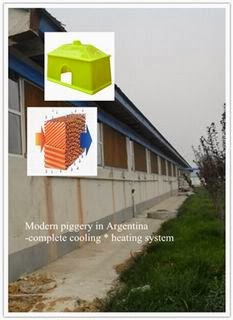
With the government funding, the pork industry has begun to install tunnel ventilation system for summer heat relief. However, the big problem for many is chilled pigs in winter conditions. The pig sale weights decline in the winter and feed conversion gets worse in winter. On the way to find out the reasons of this situation on many farms, it turns out the producers do not do a good job of minimum ventilation. They often use the tunnel curtain as the ventilation inlet for all seasons of the year, so there is no supplemental heat in winter. But on a modernized pig farm, other than the advanced breeding equipment, the complete ventilating and heating system is necessary, so now the advanced cooling and heating facilities are assembled.

Actually, in the 1980s, the swine production in Argentina has already started a modernization stage. Owing to the pig farming intensification and genetic and nutritional improvements, the productivity and quality were bettered a lot. Besides, the vertical integration from primary producers investment in slaughter plants were also observed. The important investment was made in infrastructure, facilities and confinement equipment that noticeably improved productivity levels.

Until now, many modernized large pig farms in Argentina has mechanical ventilation, generally consisting of extractors and fans; automatic feeding system; evaporation panel cooling system or water sprinkler. Of the farrowing/nursing sheds, the farms have heat systems, like thermal blankets, gas heating, radiated heat and salamander stoves. For the pregnant sows, the farms have pasture and confinement, like sow stalls and farrowing crates. And in Argentina, pigs are kept in extensive open air system, intensive confinement system, and in the combination of these two systems.

In general, by the technical efficiency and the expert skills of farmers, the pig farming industry of Argentina is well developing and well developed.
email:info@pig-farming.net or nicholepandora@gmail.com